“The Brother Who Held the Light”: Vincent van Gogh’s Final Letter to Theo
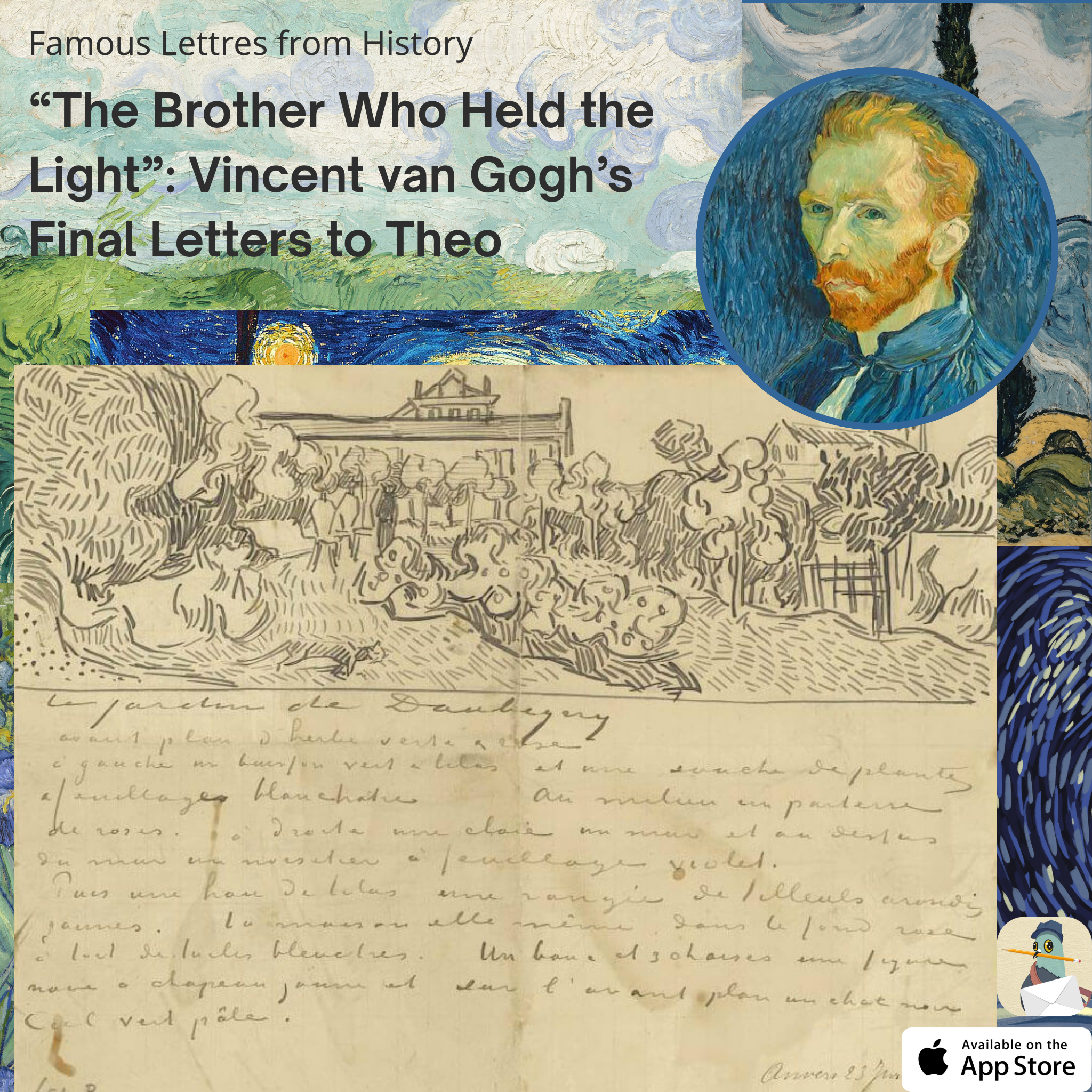
Famous Lettres from History: Van Gogh’s last letter
In the last weeks of his life, Vincent van Gogh did not paint or write confessions. He wrote observations.
From Auvers-sur-Oise, his letters to Theo van Gogh became increasingly precise. They were less about anguish, more about color, structure, and light. The emotional weight is there but it is held beneath the surface, embedded in description.
One of these letters contains a small drawing at the top of the page and, beneath it, a passage that reads almost like a painter thinking aloud. What follows is not a farewell. It is a way of seeing.
From Vincent to Theo (July 1890)
“
The Church at Auvers
Early this morning
I made another sketch
of the village, whitish
with roses.
First, a clear area in blue and green
of the rubble-stone wall with violet foliage.
Then a band of lilac, a row of linden trees, orange
and yellow.
The house itself in a russet tone,
with bluish slate roofs.
A slate bench in full
sunlight in front, and a black cat
with pale green.
(Auvers, July 1890)
“
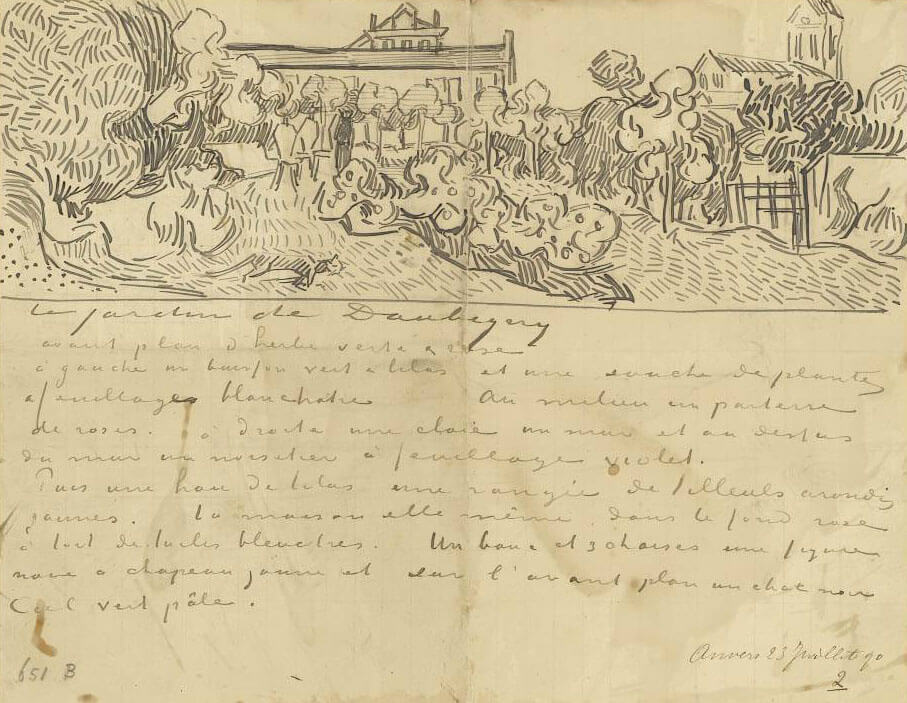
The Letter itself, preserved to this day
(Source:- **Petros Antoniou)**
A Letter That Paints
This is not how we expect a man at the edge of life to write.
There is no grand summation. No dramatic closing line. Instead, Vincent inventories the world in front of him: walls, foliage, rooftops, a bench, a cat. Each object is assigned a color, each color placed carefully beside another. The letter reads like a palette laid out in words.
What is striking is the calm authority of the language. Vincent is not doubting himself here. He is not asking Theo whether the work is good. He is explaining; quietly, confidently what he sees and how he intends to render it.
In these lines, Theo is not merely a recipient. He is a witness.
Theo’s Role Between the Lines
Throughout Vincent’s life, Theo was the constant presence on the other side of the page. He provided money, encouragement, and belief, but more importantly, he provided attention. Vincent wrote because someone was reading.
Even in this final letter, Vincent is still sharing process. Still translating vision into language. Still trusting that Theo will understand why blue must meet green, why violet foliage matters, why a black cat belongs in the composition. The intimacy is subtle, but it is everywhere.
Why This Letter Matters
This passage reminds us that Vincent did not disappear into chaos at the end of his life. He remained an artist to the last letter; attentive, deliberate, exacting. His world did not collapse; it narrowed, sharpened, intensified and Theo remained at the center of it.
If Vincent’s paintings are acts of looking, his letters are acts of connection. They show us that genius is not sustained by isolation, but by being seen by someone patient enough to listen, and steady enough to stay.
Lettre’s Reflection
There is a temptation to read Vincent van Gogh’s final letters as clues pointing toward an ending we already know but this passage resists that impulse. Nothing here asks to be solved.
Instead, the letter insists on attention. It slows us down. It asks us to look at what remains when drama is removed: a wall, a roof, a bench, a cat resting in the sun. In naming these things, Vincent preserves them. In sharing them, he trusts that they matter. Perhaps this is the quiet truth of the letter.
That even near the end, Vincent was not consumed by darkness, but occupied by looking. That his final act was not despair, but description. And that the person he chose to describe the world to again and again was his brother.
Some relationships save us loudly.
Others do so simply by staying.
In this letter, we see what it means to be held; not by answers, but by someone willing to receive the details of your seeing, one color at a time.
That may be the most enduring legacy of these letters. Not tragedy, but tenderness.
Some letters try to explain a life. This one simply shows us how a morning looked and somehow, that is enough.