The Friend Who Broke the News | Mozart's Letter on the Death of His Mother | Paris, 3 July 1778
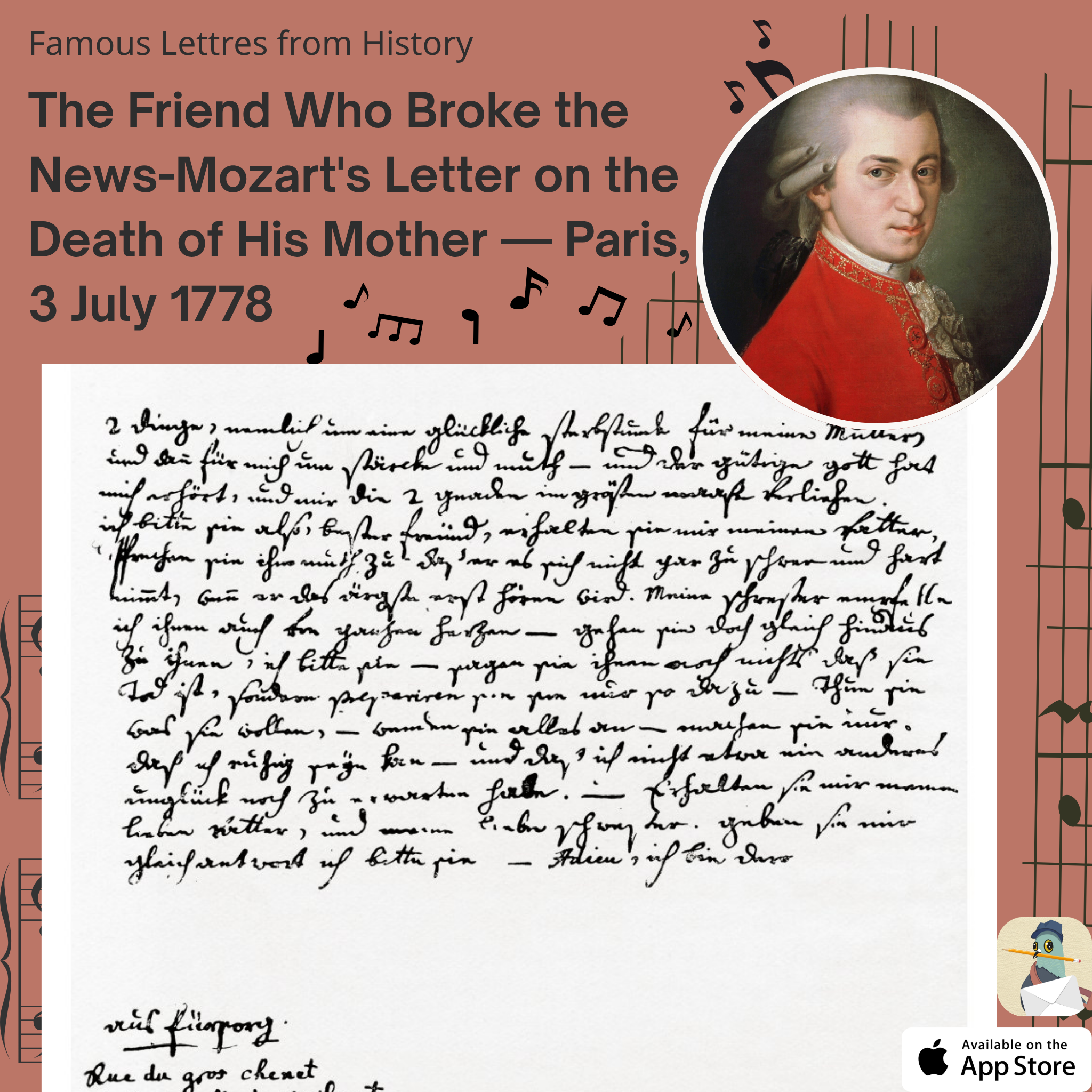
Mozart's Letter on the Death of His Mother — Paris, 3 July 1778
In the summer of 1778, a twenty-two-year-old Wolfgang Amadeus Mozart sat alone in a rented room on the Rue du Gros Chenet in Paris, at two o'clock in the morning and wrote the hardest letter of his life. His mother, Anna Maria, who had crossed half of Europe with him in search of a job that never quite arrived, had just died beside him. He could not bring himself to tell his father directly. So he wrote to a family friend instead, and asked him to break the news gently.
A Mother Who Came Along
Anna Maria Mozart was not supposed to be the one who went. In September 1777, Wolfgang, then twenty-one, set out from Salzburg to find a paying position worthy of his talent, chaperoned by his mother rather than his father, Leopold, who was refused leave by the archbishop. Mother and son made their way through Munich, Augsburg, and Mannheim, where Wolfgang fell for a young soprano named Aloysia Weber and lingered for months chasing a job that Leopold, back home, could see was never going to materialize. By the time they reached Paris in March 1778, money was tight enough that they had already pawned some of their belongings, and the city itself, crowded, indifferent, and unimpressed by a wandering composer, wore on both of them.
Anna Maria's health had been fragile for years; legal records from her own youth describe her as chronically unwell. In Paris that spring, chills, fever, and headaches set in, and by mid-June she was gravely ill. A doctor bled her; home remedies followed. She rallied briefly, then declined. On 3 July 1778, at twenty-one minutes past ten in the evening, she died, with only her son and a family friend named Joseph Haina at her bedside.
A Letter Written to Delay the Truth
Mozart could not face telling his father and sister the truth all at once. That same night, he wrote two letters. One went to Leopold, and said only that his mother was gravely ill, buying time and softening the blow he knew was coming. The other, written in the same sitting and marked for the recipient's eyes alone, went to Abbé Joseph Bullinger, a Jesuit tutor and close family friend back in Salzburg, whom Mozart trusted enough to call, in his own words, the best of all his friends.
In it, he abandoned every pretense. He told Bullinger plainly that his mother was gone, and asked him to go to Leopold and Nannerl at once, not with the news itself, but to prepare them for it, gently, so the shock would not land all in one blow. He described sitting by her side as she slipped into delirium and then unconsciousness, describing how her breathing and senses failed hour by hour until the end came just after ten that night. He wrote of surrendering to what he called the will of God, of asking for only two things as she lay dying: an easy passing for her, and the strength to bear it himself. He signed it, as he always did to his father's oldest friend, as an obedient and grateful servant, and begged for a reply by return post so that he would know how to act next.
Six days later, once he judged that Bullinger would have done his work in Salzburg, Mozart finally wrote to Leopold with the truth itself, in a longer letter that mixed grief with an almost businesslike account of the illness, the doctors, and the funeral arrangements he had had to handle entirely alone in a foreign city. He asked his father's forgiveness for the small, necessary deception, explaining that he could not bear to surprise him all at once with news so terrible.
Leopold's reply, when it came in August, was not entirely the comfort his son may have hoped for. Grief-stricken himself, he pressed his son for details of the illness and, in the same letter, suggested that closer attention might have caught the danger sooner. It is one of the more painful exchanges in the whole of the Mozart family correspondence: a son trying to protect his father from pain, and a father, in his own pain, turning some of it back on his son.
What Became of the Letter
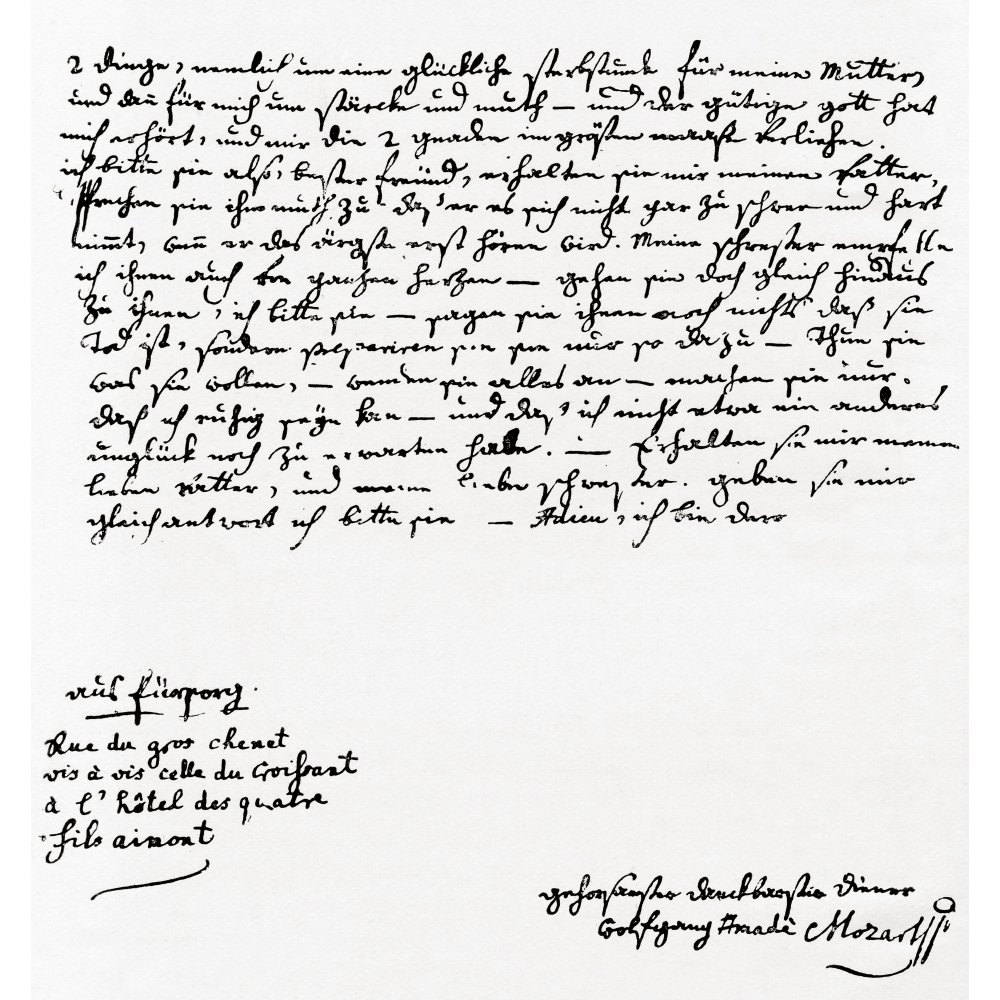
The original letter to Bullinger has since been lost; what survives is a facsimile and early copies made not long after Mozart's death, which is how its text has come down to us at all. Mozart stayed on in Paris for weeks after his mother's burial, finishing an opera ballet and drifting through a city he had come to dislike, before finally starting the long journey home that autumn, arriving back in Salzburg without her.
(Source-Walmart) I know i am surprised as well
The Letter Itself
A close rendering and English transcript of Mozart's letter to Abbé Joseph Bullinger:-
“
Paris, 3 July 1778, written for Bullinger's eyes only:
Best of friends,
Mourn with me, my friend. This has been the saddest day of my life. I am writing to you at two o'clock in the morning, and I must tell you that my mother, my dear mother, is no more.
God has called her to Himself. He wanted her, I could see that clearly, and so I have given myself over to His will, since it was He who gave her to me, and He who could take her away again. You cannot imagine what fear and worry I have carried these past two weeks. She died without knowing it, like a candle going out. Three days before the end she confessed, took communion, and received the last rites, but for those final three days her mind wandered constantly, until today, when just after five in the afternoon her senses began to leave her entirely. I held her hand and spoke to her, but she neither saw nor felt me anymore. She lay like that for five hours, until she slipped away at twenty-one minutes past ten in the evening. No one else was present besides myself, our good friend Herr Haina, whom my father knows, and the woman who had been sitting up with her.
I cannot tell you the whole story of her illness today. I only believe that she had to die; it was God's will. All I ask of you now is this one act of friendship: go to my poor father, very gently, and prepare him for this news. I have written to him by the same post, but told him only that she is gravely ill, so that I may wait for his answer and know how to proceed from there. May God give him strength and courage.
I found my own comfort some time ago, not only now. By God's grace I have borne all of this with steadiness. As the worst drew near, I asked God for only two things: a peaceful hour of death for my mother, and courage for myself, and our merciful God granted me both in full measure.
I beg you, best of friends, save my father for me. Give him courage, so that when he finally hears the worst, he does not take it too hard. I commend my sister to you too, with all my heart. Go to them at once, I beg you. Say nothing yet of her death; only prepare them for it, however you think best, so that my mind can be at rest and I need not fear some further misfortune on top of this one. Save my father and my sister for me. Answer me at once, I beg you.
Farewell. I remain, most obediently and gratefully, your servant, Wolfgang Amadè Mozart
“
Rendered closely from the surviving facsimile and early copies of the letter, translated for readability; the original is held in fragments and transcripts rather than as a single complete autograph.