"The Word God Is Nothing But Human Weakness": Einstein's “God Letter”, 1954
Famous Lettres from History: Einstein's God Letter, 1954
In January 1954, Albert Einstein was 74 years old. He had reshaped our understanding of space, time, light, and gravity. The world had named him a genius; presidents had written to him; he had been the face on magazine covers across five continents. And yet here he was, in Princeton, New Jersey, writing a private letter to a philosopher he had never met, a philosopher whose book he admitted he might never have read on his own.
That letter would become one of the most debated, most auctioned, and most read personal documents of the twentieth century. It is known today simply as the God Letter.
How It Came to Be Written
The story begins with a book. In 1952, German-Jewish philosopher Eric Gutkind published Choose Life: The Biblical Call to Revolt, a work that attempted to reconcile Jewish scripture with a call for moral and social transformation. It was ambitious, deeply spiritual, and written in a style that leaned heavily on religious language and metaphor.
A mutual friend, the Dutch mathematician L.E.J. Brouwer, pressed Einstein to read it. Einstein resisted for some time. He eventually relented and worked through much of the book over several days. Then, on the third of January, 1954, he sat down to respond.
He wrote in German. He wrote by hand. He made corrections and emendations in the margins as he went. The result was a page and a half of one of the most candid, private, and carefully reasoned expressions of his inner life that Einstein ever committed to paper.
"The word God is for me nothing but the expression and product of human weaknesses."
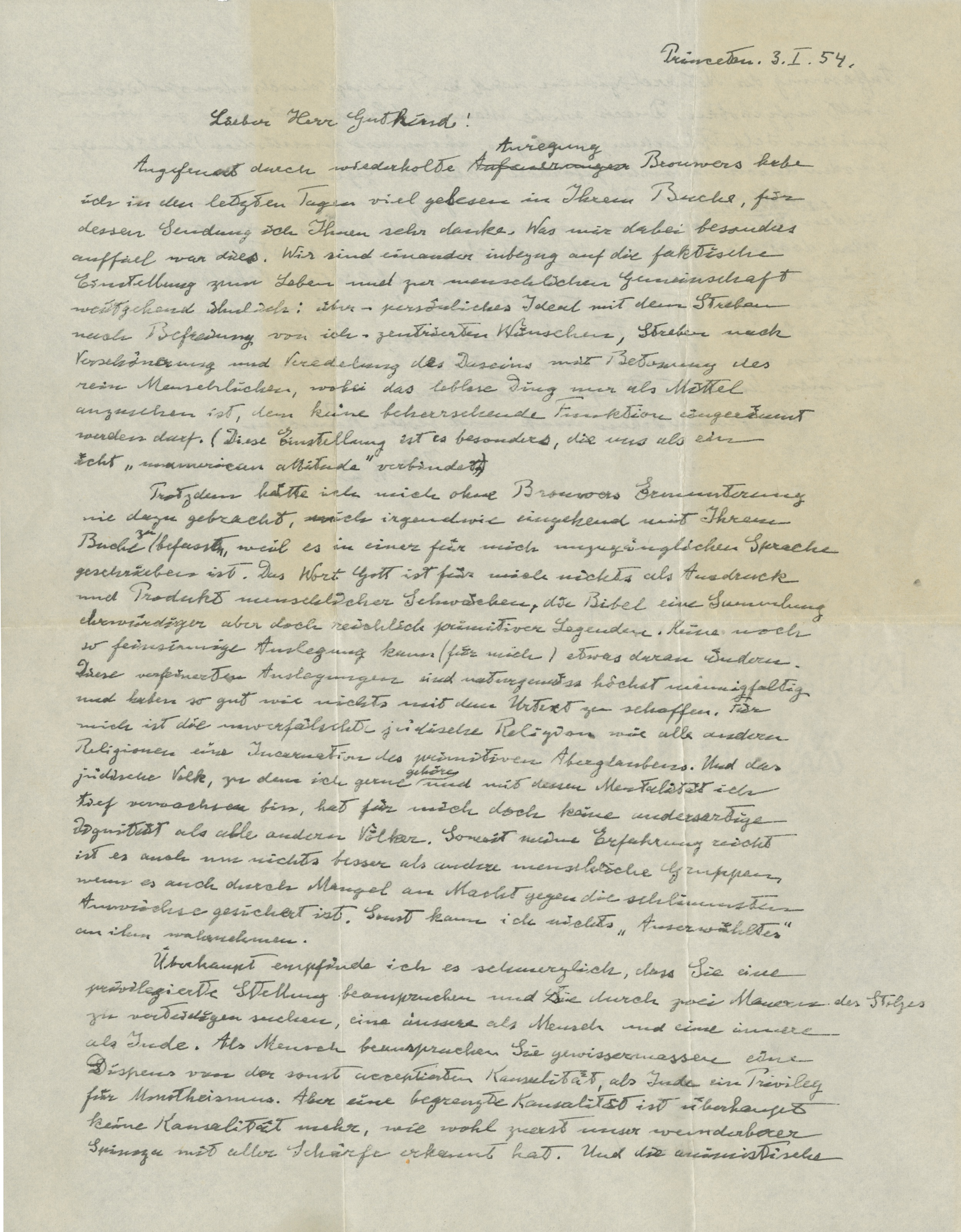
Letter written by Albert Einstein’s own hand (part 1 of 2)
(Source: Christie's)
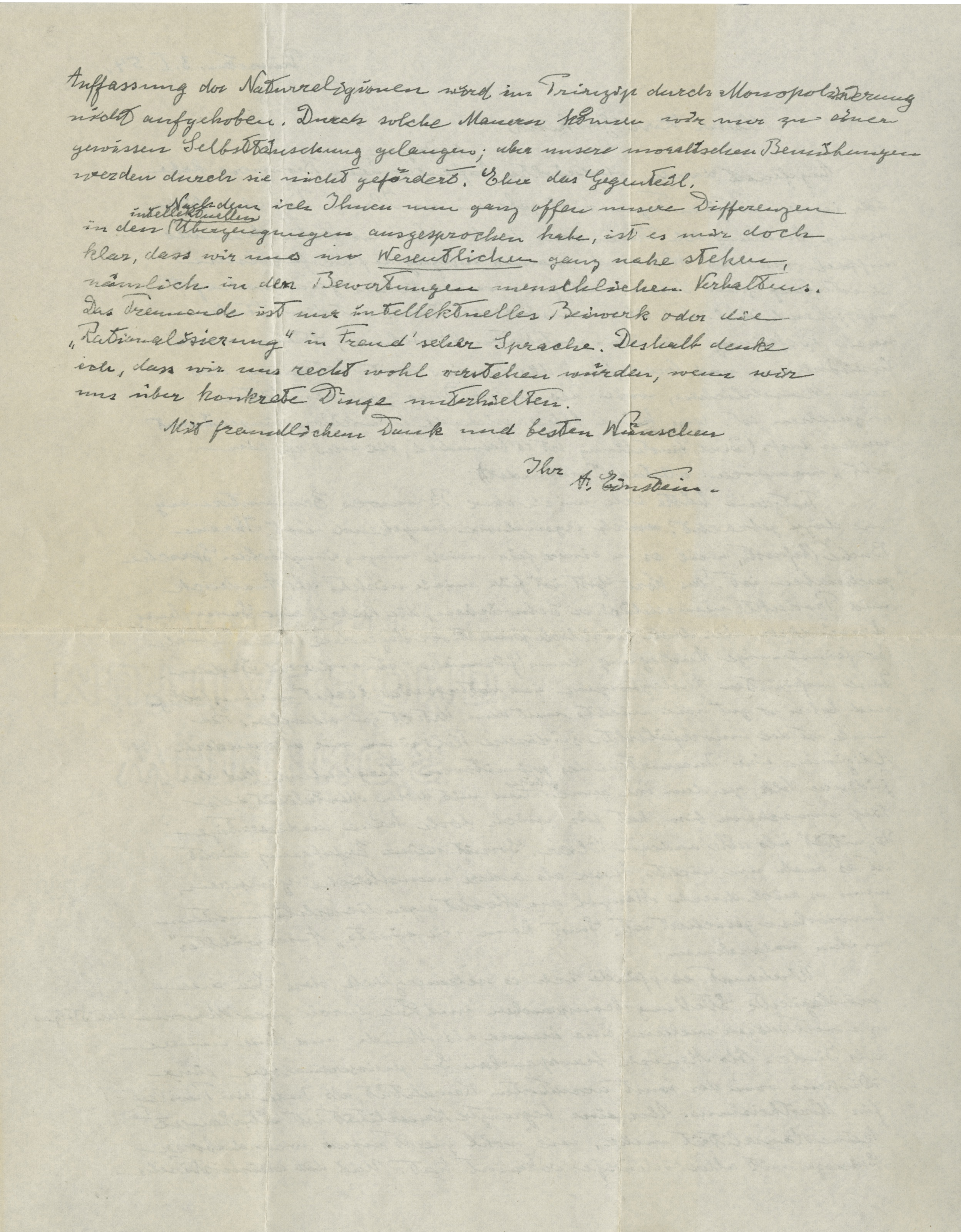
Letter written by Albert Einstein’s own hand (part 2 of 2)
Page two of the God Letter, showing Einstein's handwritten corrections and his signature "A. Einstein." (Source: Christie's)
Full Transcription of Einstein's God Letter
“
Princeton, 3. 1. 1954
Dear Mr Gutkind,
Inspired by Brouwer's repeated suggestion, I have read a great deal in your book in the last few days: thank you very much for sending it to me. What struck me particularly was this. We are largely alike as regards our factual attitude to life and to the human community: an ideal that goes beyond self-interest, with the striving for release from ego-oriented desires, the striving for the improvement and refinement of existence, with an emphasis on the purely human element, by which inanimate things are to be perceived purely as a means, to which no dominant function is to be attributed.
Nevertheless, without Brouwer's encouragement I would never have brought myself to engage at all closely with your book because it is written in a language which is inaccessible to me. The word God is for me nothing but the expression and product of human weaknesses, the Bible a collection of venerable but still rather primitive legends. No interpretation, no matter how subtle, can (for me) change anything about this.
For me the unadulterated Jewish religion is, like all other religions, an incarnation of primitive superstition. And the Jewish people to whom I gladly belong, and in whose mentality I feel profoundly anchored, still for me does not have any different kind of dignity from all other peoples. As far as my experience goes, they are in fact no better than other human groups, even if they are protected from the worst excesses by a lack of power. Otherwise I cannot perceive anything "chosen" about them.
In general, it pains me that you claim a privileged position and try to defend it by two walls of pride, an external one as a human being and an internal one as a Jew. But a limited causality is no longer a causality at all, as indeed our wonderful Spinoza originally recognized with absolute clarity. And the animistic conception of natural religions is in principle not cancelled out by monopolization. With such walls we can only attain a certain self-deception; but our moral efforts are not furthered by them. Quite the opposite.
Now that I have expressed our differences in intellectual convictions completely openly, it is still clear to me that we are very close to each other in the essentials, that is, in our evaluations of human behavior. What divides us is only intellectual padding or the "rationalization" in Freudian language. So I think that we would understand each other very well if we conversed about concrete things.
With friendly thanks and best wishes,
Yours,
A. Einstein
“
A Letter That Refused to Perform
This is not how we expect a world-famous scientist to write, especially not to a stranger.
There is no diplomatic softening here, no hedging behind professorial language. Einstein tells Gutkind plainly that he found his book largely inaccessible, that the word "God" communicates nothing to him beyond human frailty, and that the Bible is a collection of legends, honorable in their antiquity but primitive in their assumptions. He says all of this on page one. He then spends the rest of the letter making clear that he still respects Gutkind as a moral thinker, and despite everything, they share the essentials.
The structure of that letter is quietly remarkable. Einstein does not write to wound. He writes to be honest. And honesty, in his telling, is itself a form of respect.
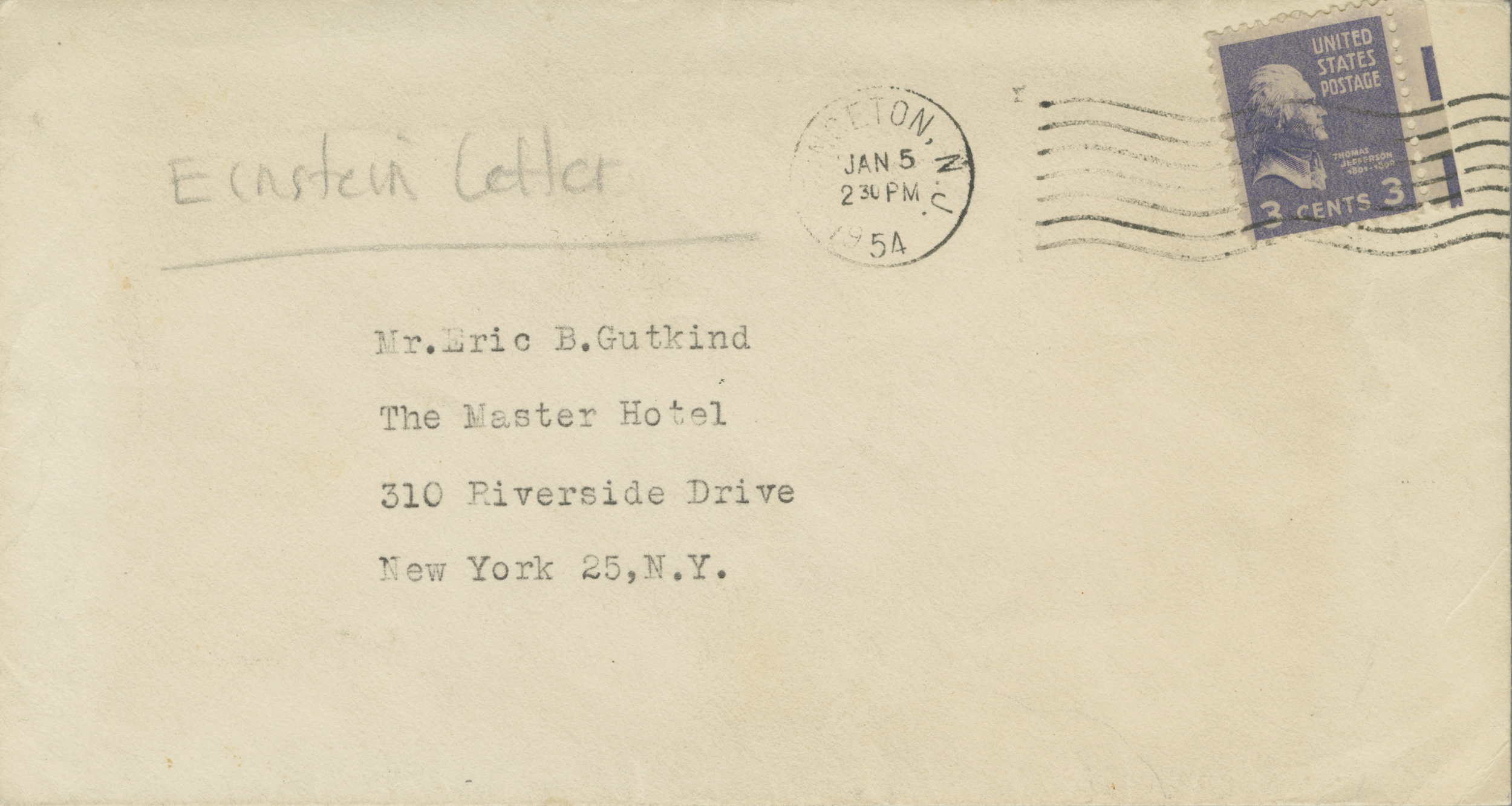
The envelope which carried Einstein’s God Letter
(Source: Christie's)
The Loneliness Inside the Clarity
What is most striking about the God Letter is not the famous line about God being a product of human weakness. That sentiment was not new for Einstein. He had circled these ideas in private notes and conversations for decades. What is striking is the particular tone of this letter: the combination of bluntness and warmth, of intellectual firmness and genuine reaching across a divide.
He tells Gutkind they are "very close in the essentials" after spending a full page disagreeing with nearly every foundational assumption of Gutkind's book. He closes with thanks. He signs off warmly. The letter is, in its strange way, an act of connection, a man reaching toward another human being across a gulf of conviction, insisting that the gulf is smaller than it looks once you strip away the metaphysics.
"What divides us is only intellectual padding. I think we would understand each other very well if we conversed about concrete things."
Why This Letter Still Shakes the Imagination
1. It Was Never Meant to Be Public
Einstein did not write this for newspapers, lectures, or posterity. He wrote it because a friend had told him to read a book, and the book had asked, by implication, for a response. The candor in the God Letter exists precisely because it was private. It surfaced in 2008, more than four decades after Gutkind's death in 1965, when it came to auction in London and sold for £170,000. The unsuccessful bidders reportedly included evolutionary biologist Richard Dawkins. In 2018 it sold again, this time at Christie's in New York, for $2,892,500, nearly twice the pre-sale estimate.
2. Einstein Was Not Attacking. He Was Thinking.
The letter is frequently read as a rejection of God, of religion, of Judaism. But that is only part of what Einstein does here. He is also doing something rarer: he is thinking out loud, carefully, about the relationship between identity and belief. He loves being Jewish. He says so directly. He feels anchored in Jewish mentality. He simply does not believe that belonging to any group grants a special claim on truth or dignity. The pain in that observation is real.
3. It Captures Einstein at His Most Human
We know Einstein through his equations. We know him through the famous photographs, the wild hair, the wide eyes, the tongue. What the God Letter gives us is something rarer: the texture of his private mind. The way he moves from diplomacy to frankness and back again. The way he invokes Spinoza, his philosophical hero, almost tenderly. The way he ends, not triumphant, not dismissive, but with something like hope.
Lettre's Reflection
There is a question that every great historical letter quietly poses: why did they write it down?
Einstein could have ignored Gutkind's book. He could have sent a polite note of thanks without engaging its ideas. He could have expressed his views privately to friends and left nothing on the page. Instead, he wrote it out: two careful pages, in his own hand, with corrections, with structure, with genuine intellectual effort given to a man he had never met and would likely never meet.
That impulse, to put the truth in a letter, to give a stranger the full weight of your actual thinking rather than a comfortable approximation, is what makes written correspondence irreplaceable.
A letter demands that you mean what you say. It asks you to sit with your thoughts long enough to form them into sentences. It creates a record that cannot be walked back or misremembered. And sometimes, a letter sent quietly between two people contains a more honest portrait of a human being than anything that was ever written for public consumption.
Einstein's God Letter is one of those.