The Olho de Boi: How Brazil's "Bull's Eye" Became the Americas' First Stamp
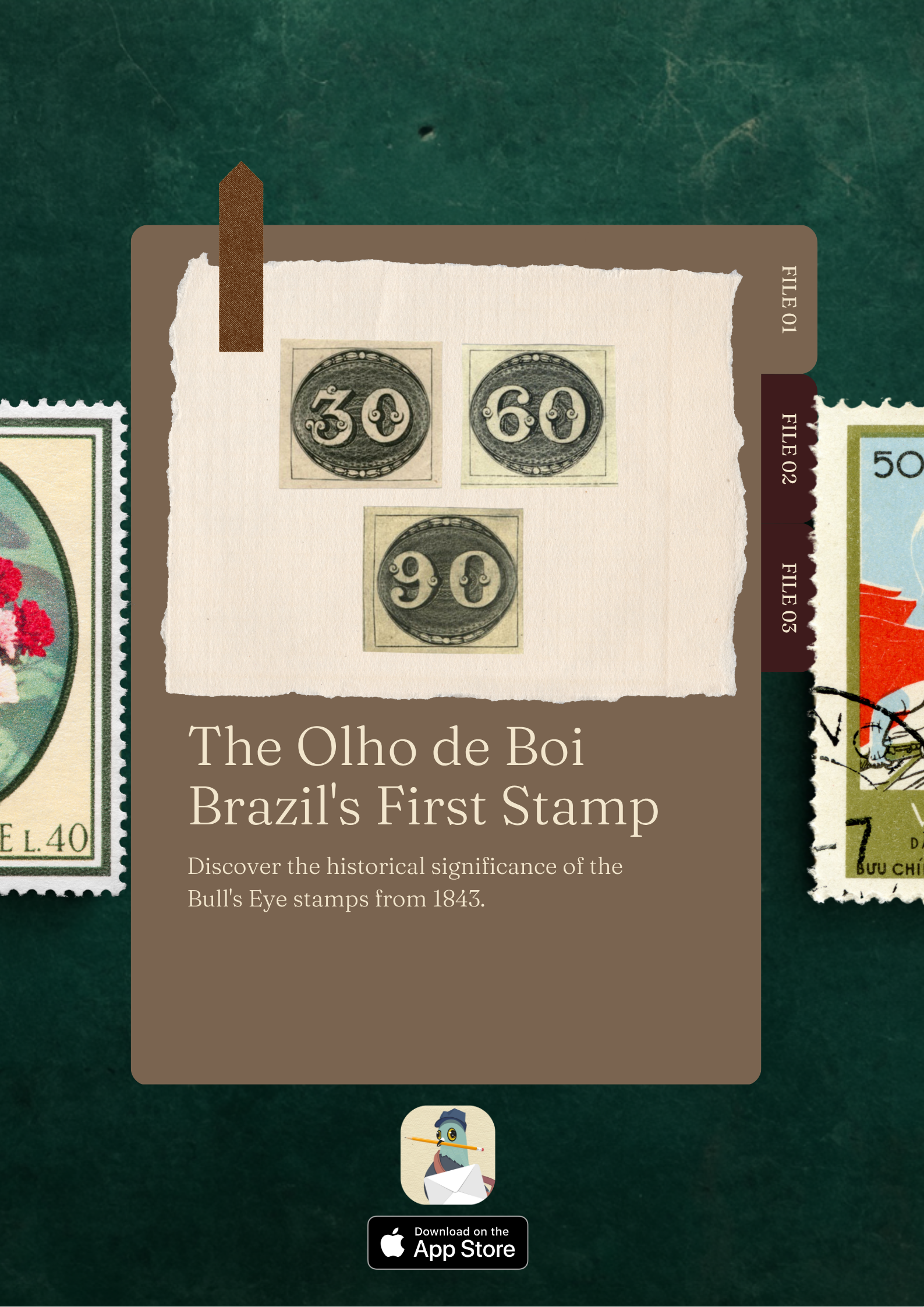
The Olho de Boi: America’s first stamp(s)
Some stamps earn their fame through rarity. Some through age. Some through error.
The Olho de Boi, which translates from Portuguese as the Bull's Eye, earns its place in history through something rarer still: it was the first postage stamp ever issued in the Americas, the first stamp ever printed in the Southern Hemisphere, and it arrived just three years after the Penny Black changed the world.
It did not carry a portrait of a monarch. It did not bear a country name. It featured something far stranger and more memorable: a large numeral set inside an oval frame, printed in glossy black ink on thin, irregular paper, arranged in sheets that looked, when you stepped back and looked at a pair of them side by side, exactly like a pair of staring eyes.
The postal workers of Rio de Janeiro took one look and gave it a nickname that has outlasted the empire that printed it.
Country: Empire of Brazil
Date of issue: August 1, 1843
Denominations: 30 réis (domestic letters), 60 réis (longer distances), 90 réis (international mail)
Designer: Engraved at the Brazilian Mint, Rio de Janeiro, likely adapted from a banknote design
Total Printed:- Approximately
856,617 of the 30 réis
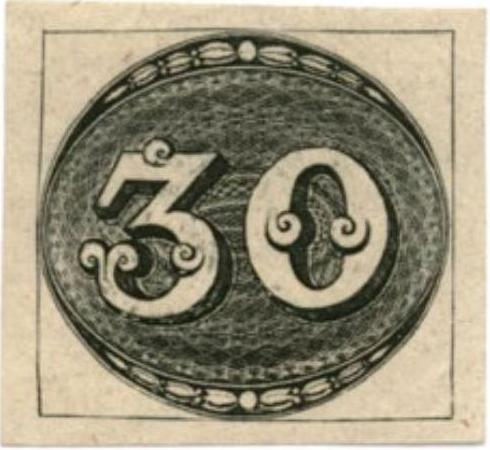
the 30 réis
(Source: Wikipedia Commons)
1,335,865 of the 60 réis
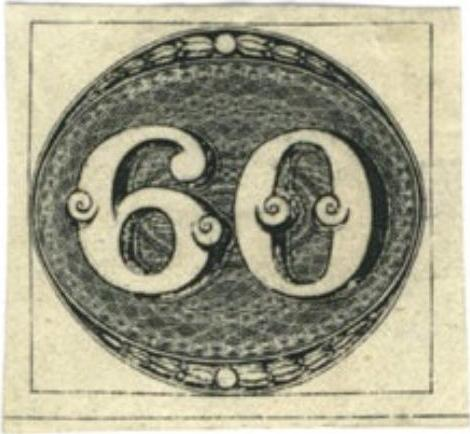
the 60 réis
(Source: Wikipedia Commons)
341,125 of the 90 réis
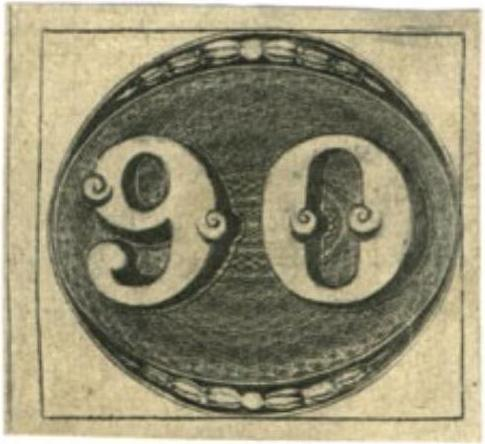
the 90 réis
(Source: Wikipedia Commons)
In circulation: August 1843 to 1850, with remaining stocks burned at the Mint on March 30, 1846
Historical significance: First postage stamp of Brazil; first stamp issued in the Americas; second country-wide stamp issue in world history after Britain
A New Idea Reaches a New World
In 1840, when the Penny Black launched in Britain, postal reformers across the world took notice. The idea was elegant and simple: a prepaid adhesive label that shifted the burden of payment from the recipient to the sender, charged at a flat rate regardless of distance. It worked. Letter volumes in Britain doubled within a year.
Brazil was at that time an empire, the only monarchy in the Americas, ruled by the young Emperor Dom Pedro II, who had taken the throne at the age of fourteen. The country was vast, its postal routes long and difficult, and its mail system a tangle of fees, distances, and local variations that made correspondence expensive and unreliable for most of its population.
The postal administrators of Rio de Janeiro watched what was happening in Britain and began drawing up plans. By 1842, proposals were circulating within the Brazilian treasury. By early 1843, the decision had been made. Brazil would issue its own adhesive postage stamps, the first in the Western Hemisphere.
The stamps were engraved and printed at the Casa da Moeda, the Brazilian Mint in Rio de Janeiro, on a machine-engraving press that was already used for banknotes. The design was pulled from that same tradition: a large, bold numeral representing the denomination, set inside an ornate oval frame, the whole thing surrounded by intricate engine-turned linework designed to make forgery difficult.
They were printed imperforate, in sheets, with no gum on the back. Buyers cut them apart with scissors. To attach them to letters, they were moistened with paste or water and pressed on. The system was not elegant, but it worked.
"The postal workers of Rio de Janeiro took one look and gave it a nickname that has outlasted the empire that printed it."
Why They Called It the Bull's Eye
The official name was simply the first issue of Brazil. But postal clerks, envelope-sorters, and letter-carriers had their own vocabulary, and they found the official name dull.
When the stamps were printed in sheets, the 30 réis and 60 réis values were arranged side by side in alternating columns. Two stamps of different denominations, each featuring a large circular numeral in its oval setting, sat next to each other on the sheet. From a short distance away, the pair looked exactly like two eyes staring back at you.
Someone called them Olhos de Boi. Bull's Eyes. The name spread through the postal offices of Rio de Janeiro and, eventually, through the whole of philatelic history.
The nickname stuck so firmly that today, nearly 180 years later, no serious philatelist refers to them as anything else.
The Stamp That Was Burned
The Bull's Eye was in active use from August 1, 1843. In the provinces, the stamps arrived more slowly: some regional post offices did not begin using them until well into 1844. The printing ran until the end of 1843, and the remaining unsold stock continued to be sold until August 22, 1844, when authorization for further sales was granted officially.
After that, something happened that is almost unique in philatelic history. The remaining stock, the unsold sheets of Bull's Eye stamps sitting in the vaults of the Brazilian Mint, were deliberately destroyed.
On March 30, 1846, they were taken into the courtyard of the Mint and burned.
No one recorded exactly how many were destroyed. But the burning is why Bull's Eye stamps, despite being issued in quantities of hundreds of thousands, are rarer than their print runs suggest. Unused examples are particularly scarce. Many of those that survived were used on letters and subsequently damaged when the envelopes were torn open, since postal workers of the era often placed stamps on the flap of the envelope, where they were inevitably destroyed on opening.
Only around 200 covers bearing Bull's Eye stamps are known to survive today. Complete, well-centered, undamaged examples in any denomination command significant prices at auction.
The Rarest of the Three
Among the three denominations, the 90 réis is the rarest. It was reserved for international mail, meaning it was used far less frequently than the domestic 30 and 60 réis values. Fewer were printed. Fewer survived. A fine used pair on cover, one of the great rarities of South American philately, can sell for tens of thousands of dollars.
The Smithsonian's National Postal Museum describes the Bull's Eyes as among the most beautiful of all classic stamps, noting the quality of the engraving and the elegant simplicity of the design. They were, by the standards of their time, technically accomplished: the machine-turned backgrounds were complex and carefully executed, the numerals bold and clear.
A Stamp Without a Name
One of the quietly remarkable things about the Bull's Eye is what it does not say.
It does not say "Brazil." It does not say "Empire of Brazil" or "Correios do Brasil" or any version of the country's name. It says only CORREIO GERAL DO RIO DE JANEIRO, meaning "General Post of Rio de Janeiro," and gives the denomination. That is all.
This was not unusual in 1843. The Penny Black had done the same thing three years earlier, carrying only the denomination and a portrait of the Queen with no country name. In those early years of postal history, stamps were local enough that everyone knew what country they were from. It was only as stamps began to cross borders in larger numbers that the custom of printing country names took hold.
The Bull's Eye is, in that sense, a stamp from a moment before stamps had learned what they needed to say about themselves. It assumed the world was small enough that context was enough. Within a decade, that assumption would no longer hold.
It was printed for a world that had not yet learned to explain itself to strangers.
Lettre's Reflection
The Bull's Eye arrived in a world that was just beginning to understand what stamps could do.
Britain had proved the concept three years earlier. Switzerland had followed in early 1843 with the beautiful Basel Dove, a local issue for the city of Basel. And now Brazil, an empire the size of a continent, with postal routes stretching thousands of kilometers into territories that barely had roads, was joining the experiment.
What strikes us about the Olho de Boi is not the oval frame or the machine-turned background or even the fact that the remaining stock was eventually walked into a courtyard and set on fire. It is that someone in Rio de Janeiro, in 1843, looked at what a schoolteacher in England had proposed six years earlier and thought: yes. We should do this too. People want to write to each other. Let us make that possible.
The Bull's Eye was Brazil saying: we are part of this conversation.
Every country that has ever issued a postage stamp was saying the same thing, in its own language, with its own design, on its own paper. We are here. We can carry your words. Send something.
The name was an accident of geometry. Two oval numerals, side by side, catching the light in a sorting room in Rio de Janeiro, and someone laughed and said: they look like bull's eyes.
But the stamps themselves were not an accident. They were a decision. A country choosing to connect its people to each other and to the world, one small piece of paper at a time.
That is what every stamp has ever been.