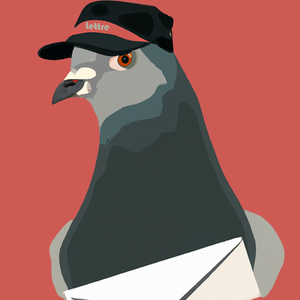
Pippin’s American Adventure
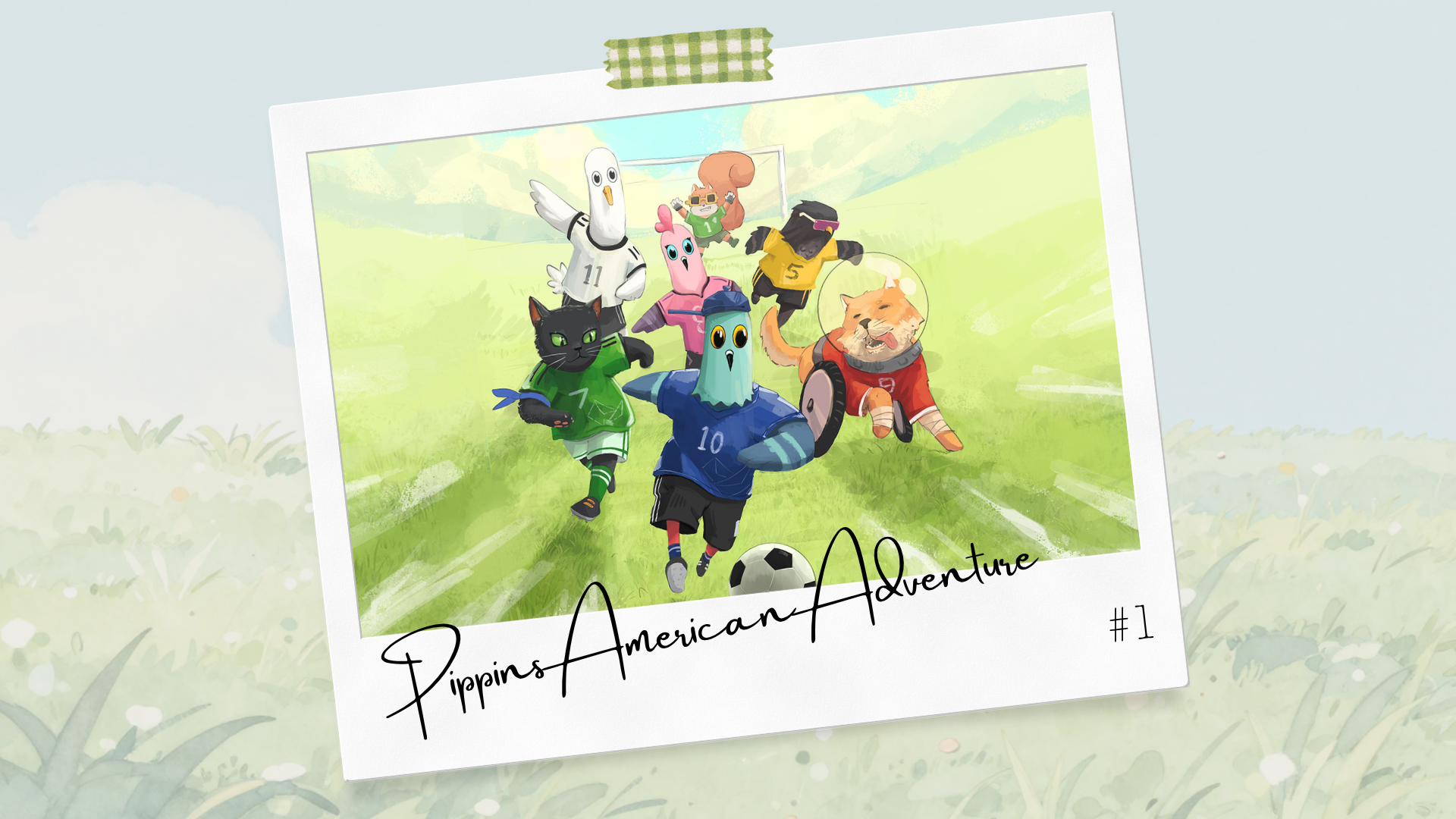
Is this a story about the world cup?
Pippin was forty two minutes late.
He could therefore dawdle another hour or so, sipping a most delicate cup of chai (sent to him by grateful Malini from Malabar in gratitude for his transcribing her mellifluously microtonal music where all the words began with M) and writing an impassioned defense of Jack Aubrey’s decision to feed Stephen Maturin’s pet sloth a slice of cake soaked in rum. “For whom among us—whom, I say, respectfully excepting the strigiformes among us, who only say WHO WHO WHO—does not crave the sweet flavors of cake, decorated in icing and fondant like a perfectly addressed envelope all smart and resplendent like a stamp!”
At this point he paused, considering how very alike were the two objects, a cake and a properly-addressed envelope. For no improperly-addressed envelope could compare itself to cake, and no self respecting cake worth the pedigree of its sugar, butter, flour, and eggs could compare to an envelope where the addressee’s name was written with no graphic, no sticker, no internal smile to confirm that the words contained within the missive were words of comfort, of serenity, one may even dare to argue of harmony and wisdom!
There were three major differences. You could fit an envelope inside a cake but the opposite required great effort In most ordinary circumstances, you could not eat an envelope There are no groovy, sarcastic 90s rock bands named after envelopes
And one unifying similarity: Cakes are covered in fondant, and you often get letters from a fond aunt.
Casually, insouciantly walking into the kitchen was our hero Pippin, forty two minutes late, not panicking at all as it is culturally taboo among pigeons to panic around that sacred number. You would have been playing castanets with your shaking knees. Lesser pigeons, superior to you in courage yet lacking Pippin’s casual intrepidity, may have dreaded terse emails from HR. The question occupying the foremost five million or so synapses of Pippin’s prefrontal cortex didn’t even register. It was considering shortbread.
“Consider shortbread!” Penny had exclaimed earlier that day, shattering the Bechdel test at her introduction into this roman fleuve, asking Malini from Malabar (or, as most of her family and friends knew her, they also being from Malabar, Malini) to think about how shortbread really was… short bread. “Without the leavening, the dough remains short, sticking to the plate and the table and the humble earth rather than reach for the skies like your boastful brioche. Being the short king of farinaceous comestibles, it tries harder. It is soft, vulnerable. Made with Madagascar vanilla and the slightest hint of sea salt, this humble biscuit soars to the heavens in taste while being forever bound by gravity to this earth.”
Though Malini was known as Malini from Malabar among the Park buddy gang, her ancestors originally hailed from Mymensingh, a district in Bangladesh. And though her ancestors were from Mymensingh, Malini herself spent her youthful days flitting about the electrical poles of Boro Mogbazar, nesting and defecating on the air conditioner unit of an apartment near Ramna, beautifying the world with her siren song, ruining early mornings for Esha Aurora. The convolutions of her itinerant family had left her with not an indifference to shortbread, but a liking more casual than Penny’s passionate fervor. “Have I told you, my dear, about the East Bengali concoction known as bakarkhani?”
But Malini from Malabar/Mymensingh/Mogbazar could hardly begin to do the subject justice, beginning with its misattribution to Mirza Abu Baqer, the original Baqer Bhai, explaining how the nanometer-thin top phyllo layer must be kissed gently by the tandoor’s fiery tongue, how entire families in Lalbagh feuded for generations over the proper way to add ponir cheese, viz before it went into the oven or afterward in a fresh, fat, moist slice, before exploring riskier territory like the Piedmontese cartographer who was said to have served Emperor Aurangzeb with a filligreed bakarkhani sprinkled with parmesan, the first recorded instance of that regal cheese in the Indian subcontinent, before the delicate latticework of the culinary conversation was shattered by a piercing scream.
“Praise be we weren’t discussing crystal, because that must have been a very high C!”, said Penny. “Aaaaaaaaaaaaaa!” shouted Pippin. “The high C! How will I fly over the high seas without my globe?”
Now, about the globe. There are two schools of thought when it comes to aerial navigation. Well, there are actually thousands, but let’s not go into how a pterodactyl feels about hang gliding. As far as the current conversation is concerned, there are two schools of thought when it comes to aerial navigation. The far more popular, modern school relies on satellite navigation. You beep into the sky, something beeps back, and as long as you don’t suffer from beep-deafness (guys, don’t worry, all humans are beep-deaf just as no bird is reading this in the subway), you can rely on the beep for context clues such as “3.5 miles to Dunkin Donuts” if you’re anywhere in the US or “3.5 feet to Dunkin Donuts” if you’re in Massachusetts. Straight forward although it relies on thousands of spaceships hurtling over earth. The second, far more charming, warm, cozy, huddle around the fireside with your buddies kinda method, is the globe. The earth, represented in an oblate spheroid, with a textured surface denoting absolutely everything, from the Himalayas as tiny bumps, to say the Chrysler building as a tinier bump, down to the last molecule of a lemonade stand that’s a bump so infinitesimal that it can only be said to exist notionally. But, notionally or not, it existed.
As you can imagine, our doughty protagonist Pippin was the sole scholar of that second school, its only pedagogue, its only student, its master, its wit, and its flouncing bouncing fool dancing a rigadoon when everybody else moved in the coordinated circle of the allemande. He believed in the globe, hanging from his neck in a tiny golden chain, weightless in its metaphysical magnitude, guiding him to every corner of the terraqueous world.
Think about it. If you’re a pigeon tasked with delivering letters in every known city (and counting!), you cannot be practical. You cannot be scientific. The rhizomatic vicissitudes of planetary delivery needed something more tangible, something both magical and prosaic, something so real in its metaphor so as to expose the conceptual guardrails of physics as the flimsy spiderweb they essentially were. You need a globe.
Pippin needed his globe. Pippin could not find his globe. If he had his globe, he could have used his globe to locate his globe. But the globe was missing, and the globularity of the situation had him running in circles.
“I must have my globe, it means the world to me!” said Pippin. Penny looked at him with an admixture of sympathy, patience, and the knowledge that Pippin could in make an exception, use satellite navigation this one time, and find his globe later. Right now, Pippin was swimming in the deep waters of self-pity; to pull him out would be as rude, in pigeon culture (hey, I’m making this shit up as I go along too), as wink-gunning your friend’s mom. Not the worst thing in the world but why’d you do that anyway?
“Alas, my poor globe! Do you know, Penny, I was flying over the Mojave desert last week, and I was so thirsty, and I remembered that my globe was an actual miniaturized copy of the earth, and so what I did was I took it and I sipped out all the water from the oceans and rivers, and it was like, a whole thimbleful, and my thirst was satiated! Ahhhh my globe, my globe, you were my whole world, you were my friend, you were my cup when I was thirsty!”
A whole eighteen minutes had passed since the start of this story, as time moves in a non-parallel, non-linear, slantendicular ambulation. Pippin was over an hour late.
Penny knew this. Penny also knew, with increasing certainty, that if Pippin didn’t hurry up and go about his deliveries right now, nay, five minutes ago, he was going to be so late for tomorrow that he’ll be early for next week. “What are you gonna do, Pippin?” In this casual question was the strong, repeated admonishment—“What you should do, Pippin, if you know what’s good for you, is stop crying over your so-called globe flask, this globular airborne cup, realize that you’re just an hour late, and drink another cup of this floral chai from Malini. Let the wild bergamot tame you, let the clover honey soothe your mind, and then, you big dumdum, use GPS! Or just look for it, find it, and then go about your delivery!!!”
Pippin was poppin’ but there was a small part of his mind, the thaumaturgical gland that anthropomorphic pigeons possess that conveniently lets them grasp the gist of what their friends are thinking. Or maybe it was pretty obvious.
“You’re right, Penny.” Pippin shook his rectrices, adjusting the filaments for aerodynamics and comfort. “The situation calls for chai. Bring forth a steaming mug, let me ponder. I will retrace my steps, revisit my flight paths, to recall where exactly I last left my beloved globe. Over which desert did I fly when, overcome with weariness, I lifted my globe to my beak and downed a restorative sip of ice cold water? Where did I leave my beloved globe, my cup? It meant the world to me!”
“You’re right, Penny.” Pippin said again. He put on a pair of really cool aviators. (Maverick’s, he was gonna drop it off later, but for now they looked freakin badass.) “I’m gonna drink me a cup of tea. Then I’m gonna find my globe. My world. My cup.”
“That’s right.” Pippin looked directly into your, the reader’s, eyes, as if you were a camera. “I’m gonna go find the World Cup.”
TO BE CONTINUED